Die Cut + Silk
Learn about Silk →The silhouette draws the eye while the soft silk-laminate surface makes the whole card feel considered in the hand.
Starting at $87 · 250 cards
Shop this Combination →

Custom shape, laser cut, through cut, and SilkCards signature face cut reveals — made possible by multi-board construction. Built from finished boards, our 32pt and 48pt cards can be shaped, cut, and revealed with purpose.
From $87 · 250 cards
The silhouette draws the eye while the soft silk-laminate surface makes the whole card feel considered in the hand.
A soft, tactile envelope for the custom silhouette. The cut shows; the touch confirms.
Our signature move: cut the face board so color, foil, texture, or artwork shows from the middle board. Best when the card should feel built, not just printed.
Best when the shape catches the eye and the metal carries the brand — the silhouette frames the metallic mark.
Best when clear gloss highlights the cut's negative space — gloss tracing the silhouette or filling the face cut window.
Clean silhouettes, tabs, notches, rounded profiles, and brand shapes that change the card before it is even read. Best when the outline is the statement.
Real feedback from trusted professionals who expect more than ordinary business cards.
We've helped brands turn paper, shape, texture, and finish into confidence that makes stronger first impressions.
Get a sample kit and feel the cut profile on real premium stocks for yourself.
Get guidance on plane choice, shape source, stock compatibility, and finish combination.
Two choices define every die cut: where the cut lands — into the face to reveal the board beneath, or through the outer edge to reshape the card — and how it’s made — a steel die for clean, simple forms, or a laser for intricate detail.
Clean geometric openings — circles, triangles, simple forms — cut into the card's face to reveal the color board beneath.
Requires 32pt or 2+ boardsThe card's outer edge cut into a custom silhouette with a steel die — best for bold, rounded, simple contours.
Works on most stocksFine, dense detail lasered into the face — patterns too intricate for a steel die — revealing the board beneath.
Requires 32pt or 2+ boardsThe outer silhouette lasered with intricate, serrated, or highly detailed edges a steel die cannot hold.
Works on most stocks“I cannot thank this company enough! My business cards are absolutely fabulous and I have received so many compliments on them. The pictures will not do them justice. I got the suede finish, 48 pt thick cards with silver foil on one side and the edges. They are so luxurious.”
Die cut is best for professionals and brands whose identity is built on form — for whom a rectangle is not enough to say what the brand actually is.
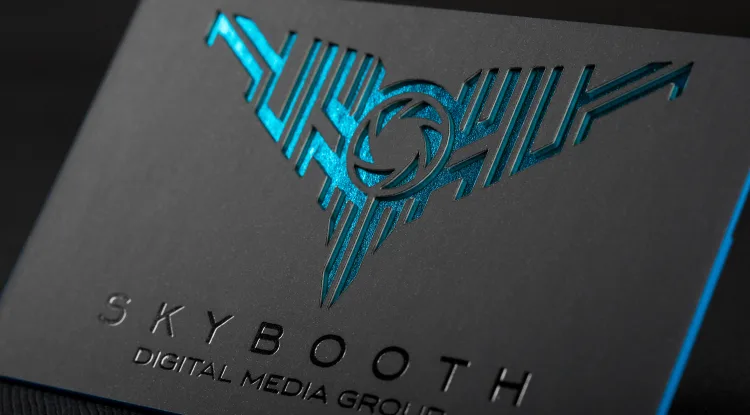
The shape itself becomes part of the portfolio. Custom silhouettes, face cuts, and through cuts show taste before the typography reads.
See studio ideas →The silhouette tells the eye what kind of brand it holds. The multi-board reveal tells the hand how the card was built. Used with intention, die cut turns a flat printed rectangle into a physical brand object.
A custom shape says "we don't belong in this stack" before the typography even reads.
Face cuts and through cuts let the construction become visible. The card is no longer just printed; it is built.
The outline of the card mirrors the outline of the logo, the type, the identity. One design language across every plane.
Die cut + foil + emboss layers the impression across every surface of the card.
Die cut is hard to judge on a screen. A sample kit lets you feel the cut profile, see shape, face, and through planes in real premium stocks, and choose the shape with confidence — and it ships free.
Send us your logo, sketch, or inspiration image. We will recommend whether your card should use a standard die, laser die cut, through cut, or face cut reveal — and turn it into a print-ready die cut card.
Keep Exploring
Finished 16pt sheets bonded into 32pt, 48pt, and heavier multi-board cards — the construction that gives the cut something to reveal.
Explore ThickThe shape catches the eye; the foil carries the brand. Custom silhouettes can be wrapped in foil-pressed edges.
Explore FoilA foil-pressed or ink-sprayed edge that follows every curve of a custom silhouette.
Explore Edge Finishes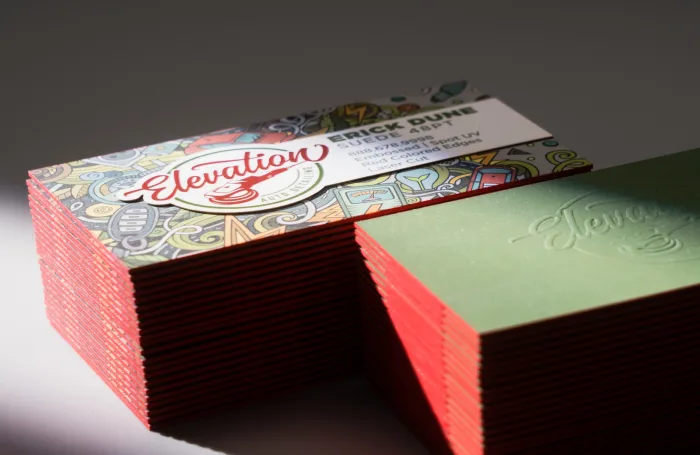
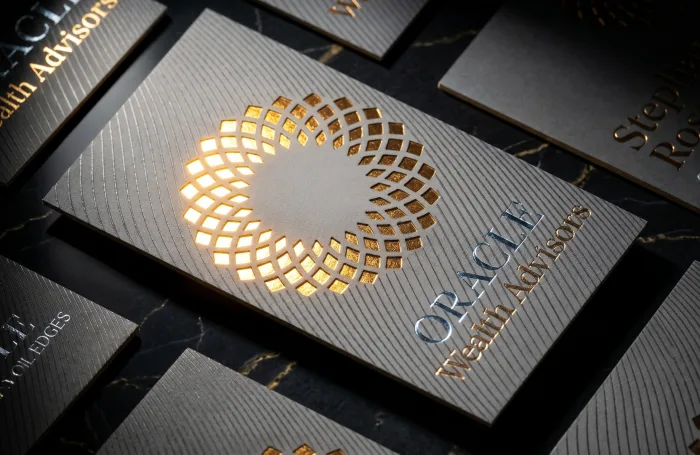
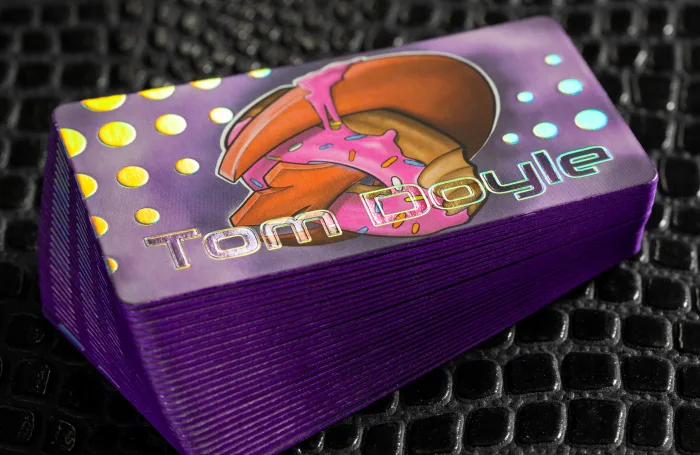
Most thick cards are one heavy sheet. SilkCards is built in layers — and that is where die cut becomes architecture, not decoration.
We bond finished boards together — two or three in one card. That gives us control over the face, edge, and middle of the card, so premium cards can be shape cut, through cut, and face cut with the finish intact.
That is how we can face cut the top or bottom board and reveal color, foil, texture, or artwork inside the card. The middle board stays intact and becomes visible through the cut — the middle board becomes part of the design.

The right die cut decision starts with the job the cut needs to perform: shape the outside, open a window, reveal a board, or carry fine detail with laser precision.
✓ A rectangle is not enough to say what the brand actually is.
✓ You want a custom shape that says "we don't belong in this stack" before the typography even reads.
✓ You want the construction to become visible — face cuts and through cuts make the card feel built, not just printed.
✓ You want the outline of the card to mirror the outline of the logo, the type, the identity.
✓ You want the cut to compound with finish — die cut + foil + emboss layers the impression across every surface.
Changes the outside silhouette of the card — logo shapes, product outlines, tabs, notches, rounded forms, brand silhouettes.
Cuts completely through the card to create an opening or window — apertures, negative space, frame effects, bold structural cutouts.
Cuts only the top or bottom board so the middle board shows through — middle-board color reveals, hidden foil, interior texture, signature multi-board effects.
Uses laser precision for fine detail and more intricate cutting — detailed geometry, small interior cuts, delicate marks, decorative patterns.
Whether 32pt, 48pt, or another multi-board construction makes the most sense for the cut you have in mind.
Vector artwork with two layers: the printable design plus a separate die-line layer showing exactly where the cut sits — our design team can build the die-line from a sketch.
Send us your logo, sketch, or inspiration image. We will recommend whether your card should use a standard die, laser die cut, through cut, or face cut reveal — and whether 32pt, 48pt, or another multi-board construction makes the most sense.
The difference is not only the cut. It is what the card is made from before the cut begins. A single thick paper stock limits the design. A SilkCards construction of bonded boards gives the cut something to reveal.
| Capability | Most Printers | SilkCards |
|---|---|---|
| Thick card construction | Usually a single pre-made thick stock or mill paper. | Finished 16pt sheets bonded into 32pt, 48pt, and heavier multi-board cards. |
| Finish on thick cards | Often uncoated or limited once thickness increases. | Silk, Suede, Linen, foil-laminate, and specialty finishes across multi-board builds. |
| Shape cutting | Often limited to thinner cards or simple shapes. | Custom shape cutting on premium multi-board constructions. |
| Face cut reveal | Not practical without true board control. | Top or bottom board can be cut to reveal the middle board beneath. |
| Middle-board design | The inside of the card is usually not part of the design. | The middle board can carry color, foil, texture, or artwork as part of the reveal. |
| Finish combinations | Limited combinations, especially on thick stock. | Die cut can combine with foil, Spot UV, emboss, edge finishes, and multi-board reveals. |
SilkCards runs die cut on cotton, suede laminate, silk laminate, foil-laminate, linen, and select wood, metal, and plastic substrates — holding clean cuts while preserving the surface character that justified choosing them. Each one has its own page when you want to go deeper.
The silhouette draws the eye while the soft silk-laminate surface makes the whole card feel considered in the hand.
A soft, tactile envelope for the custom silhouette. The cut shows; the touch confirms.
Natural fiber meets architectural form — a restrained custom shape on 100% cotton stock.
Die cut holds clean on linen while preserving the woven surface character buyers chose it for.
A custom silhouette wrapped in a foil-pressed or ink-sprayed edge that follows every curve.
A logo embossed inside the cut frame — registration tight enough to stack foil, emboss, and Spot UV on a single card.
Die cut amplifies considered design; it doesn't rescue weak design. These are the choices to avoid — and what to do instead.
At 0.5mm or below, intricate cuts on standard 14pt stock tear in production. The shape arrives broken or distorted.
Premium stocks like 32pt cotton, suede, or foil-laminate hold tighter tolerances than standard stock. Match the cut tolerance to the stock, not the other way around.
A custom die requires tooling that surprises buyers who think die cut is "just a different cut." Skipping that step compresses the schedule and increases production risk.
Custom dies carry a one-time setup. Once made, the die is kept on file and every reorder uses the same tooling at standard turnaround.
A window cut that crops the brand mark or amputates a phone number damages both readability and credibility.
The cut should reveal, frame, or open. Never crop the work it's protecting. Treat the die-line as the first design constraint, not the last.
Random cuts without structural intent read as effort without idea. Fussy, not considered.
Shape, face, through. Every plane of the cut should reinforce what the card is for. The shape is part of the brand statement, not a flourish on top of one.
The essentials most buyers ask before choosing die cut — short and to the point.
Because our thick cards are built from finished boards, not one solid block of paper. Two or three are bonded into one card. Since the boards are independent before they are bonded, SilkCards can shape the outside, cut through the structure, or face cut the top or bottom board to reveal the middle board beneath.
A face cut reveal cuts only the top or bottom board of a multi-board card. The middle board stays intact and becomes visible through the cut. That middle board can carry color, foil, texture, or artwork.
Shape cut changes the outside silhouette of the card. Face cut changes the surface architecture by revealing a board beneath the face of the card.
Choose laser die cut when your design has delicate details, small interior openings, or complex geometry that needs more precision than a traditional die can hold cleanly.
Die cut business cards use a custom-tooled die to cut the card on any of three planes SilkCards calls the Spine: Shape cut (the outer perimeter), Face cut (partway into the surface for windows and reveals), and Through cut (all the way through for silhouettes and apertures). The shape becomes part of the brand identity, not a printed graphic on a standard rectangle. Most printers offer one plane; SilkCards executes all three.
The Spine is what SilkCards calls the three planes of die cut. Through cut goes completely through the card (silhouettes, apertures, perforations). Face cut goes partway into the surface (windows, kiss cuts, peelable reveals). Shape cut defines the outer perimeter (custom outlines, scallops, asymmetric profiles). Most printers offer one plane. A few offer two. SilkCards executes all three on premium stocks, and the strongest cards often combine two or three.
SilkCards' die cut business cards begin at 32 point. This is the Silk Standard. 48 point and 64 point multi-board constructions are also available with intricate cut work intact. Most premium competitors cap die cut on cards at 14-16 point because thinner stocks tear or fray under the tooling. SilkCards' baseline is roughly twice that thickness, and the cuts hold across all the heavier weights.
Yes. This is where SilkCards separates from the field. Most standard print workflows decline intricate die cut on cotton, suede, or foil-laminate because these materials require more care than ordinary card stock. SilkCards has built the experience to hold clean cuts on these premium substrates while preserving the texture buyers chose them for. The result: shape and material work together, not against each other.
Yes. Die Cut + Foil is one of the most-ordered combinations on the configurator. The shape catches the eye; the foil carries the brand. Custom silhouettes can be wrapped in foil-pressed edges. Face cuts can frame a foil-printed area beneath. SilkCards holds tight registration so the foil sits cleanly inside or alongside the cut, even at intricate tolerances.
Die cut earns its place when the rectangle no longer says what the brand actually is. The cards become artifacts people keep. Conversation pieces, not entries in a stack. Worth is measured by the moment of handover, when a custom silhouette announces the brand before the typography reads. For brands whose identity is built on form, die cut across any of the three planes can be the move that makes the card feel unmistakably theirs.
Rounded corners use a fixed-radius jig that every printer offers. A basic finish applied at the end of the run. Die cut means a custom-made die for a specific shape on any of the three planes of the Spine. Custom dies require additional preparation before production but produce a silhouette no other brand can run on the same die. Once made, the die stays on file for every reorder.
Die cut is the most common method for shaping a card and the strongest at production scale. Kiss cut is a shallower face-only variant, leaving the back intact for peelable layered reveals. Laser cut is reserved for intricate filigree patterns that exceed the tolerance of a standard die. All three live on the Spine's Shape, Face, and Through planes, and SilkCards selects the right method for your artwork.
SilkCards runs die cut on cotton (32pt and heavier), suede laminate, silk laminate, foil-laminate, linen, and select wood, metal, and plastic substrates. The Silk Standard for die cut begins at 32 point, roughly twice the 14-16pt industry cap. Most standard workflows decline intricate die work above 16pt because premium stocks require more care than ordinary card stock. SilkCards holds clean cuts while preserving the surface character that justified choosing them.
Yes, and the combinations are among the strongest in the catalog. A custom silhouette with a logo embossed inside the cut frame. Spot UV gloss tracing a Through cut. A Shape cut wrapped in any of the 36 SilkCards Edge Finishes that follow every curve. SilkCards holds registration tight enough to stack foil, emboss, Spot UV, and edges on a single card, so every plane of the Spine carries the brand.
Vector artwork (PDF or AI) with two layers: the printable design, plus a separate die-line layer (a named spot color) showing exactly where the cut sits. Add 1/16 inch of bleed past the cut line so color runs clean. On 32pt premium stock, 1mm bridge widths hold; on 14pt, 2mm is the safe minimum. Keep cuts off critical type and logos. SilkCards' design team can build the die-line from a sketch.
Honest answer first: not every shape works. If artwork contains spaces too small to hold structural integrity under tooling, the cut tears or distorts. SilkCards' design team reviews every file before tooling is built and flags risk zones: bridge widths under 1mm, sharp interior corners, micro-detail below the stock's tolerance. When a shape won't hold, we propose adjustments. The goal is to ship a card that performs, not bill for a broken die.
Most die cut orders require additional time after artwork approval because custom shape work is reviewed and prepared before production. A custom shape may carry a one-time setup review; SilkCards confirms what's needed during artwork review, and your proof shows the schedule before the order moves forward. Once made, the custom die is kept on file so future reorders use the same approved tooling, which keeps small-run reorders simple.
Die cut lands strongest for brands built on form: creative directors, architects, hospitality, luxury retail, fashion, photographers, founders shipping a flagship product. Skip it in three cases: when the card is meant to disappear quietly into a wallet, when the run is small enough that custom die setup outweighs the impact, or when the design hasn't earned the shape. Die cut amplifies considered design across the Spine; it doesn't rescue weak design.
Depends on the shape, and the choice is part of the design intent. A custom silhouette within 3.5"×2" on 32pt premium stock fits any standard wallet and is durable for typical pocket use. A shape that breaks that envelope won't fit a wallet by definition, which is often the point. The recipient keeps it on a desk or shelf. SilkCards' design team flags any structural risk and clarifies the trade-off before tooling.
Yes. Most first-time die cut customers do. A custom shape on a screen is a graphic; the same shape on premium stock in your hand is an object. The sample kit shows examples across all three planes of the Spine (Shape, Face, Through) on multiple stocks, so you can match the cut to the material before choosing a custom die. Sample kits are free.