Raised Foil + Silk
Learn about Silk →Smooth silk-laminated 32pt+ stock — the premium base raised foil sits highest on.
Starting at Coming soon · price not set yet
Shop this Combination →

Turn your logo, name, or signature mark into a raised metallic detail people notice with their eyes and confirm with their hands. True raised foil that stands higher than the shallow “raised foil” most printers offer — with variable elevation, 38 foil colors, and a premium 32pt+ Silk or Suede foundation.
Pricing coming soon
Raised Foil is a brand new product — pricing is still being set up.
Every price on this page reads “coming soon” because no raised foil price exists yet. Real raised foil photography is starting to arrive — a few combination cards below are still waiting on theirs.
Smooth silk-laminated 32pt+ stock — the premium base raised foil sits highest on.
Deep black stock that throws gold and silver raised foil into sharp relief.
Color edge or foil edge can add depth without crowding the design — the card feels finished from every angle.
Raised foil is a dimensional choice, not only a color choice — the stronger the elevation, the more the foil lifts off the surface.
A raised mark invites touch, and touch is what makes a card memorable long after the conversation ends.
Many cards use both — metallic foil for the logo, raised Spot UV for a background pattern.
Real feedback from trusted professionals who expect more than ordinary business cards.
We’ve helped brands turn paper, foil, texture, and finish into confidence that makes stronger first impressions.
Get a sample kit and experience the shine, texture, weight, and finish for yourself.
Get guidance on the right combination of foil, stock, texture, and edge detail.
Gold and silver are the classics, but raised foil comes in 38 colors across five families — so the finish can match your brand instead of defaulting to metallic.
The right color depends on your stock and how much contrast you want — and a sample kit is the surest way to compare the foil families against your brand.
Gold, silver, copper, rose gold, black, white.
For beauty, wellness, bridal, and boutique brands.
For cards that should catch light from multiple angles.
For modern, nightlife, creative, and tech brands.
For high-impact, visual-first identities.
Solid (15): Gold, Silver, Black, Rose Gold, New Penny Copper, Orange Copper, Red, Hot Pink, Light Pink, Lavender, Purple, Forest Green, Navy Blue, Ocean Blue, Teal.
Pearlescent (7): Gold Pearlescent, Silver Pearlescent, Red Pearlescent, Rose Gold Pearlescent, Hot Pink Pearlescent, Navy Blue Pearlescent, Green Pearlescent.
Rainbow (2): Rainbow Gold, Rainbow Silver.
Facet / P1 (7): Gold P1, Silver P1, Red P1, Hot Pink P1, Navy Blue P1, Green P1, Black P1.
Speckle / P2 (6): Gold P2, Silver P2, Red P2, Light Pink P2, Navy Blue P2, Green P2.
Holographic (1): Green Pattern 3.
“I cannot thank this company enough! My business cards are absolutely fabulous and I have received so many compliments on them. The pictures will not do them justice. I got the suede finish, 48 pt thick cards with silver foil on one side and the edges. They are so luxurious.”
Flat foil gets noticed by the eye. Raised foil gets noticed by the hand — the moment someone runs a thumb across your mark and pauses. That pause is what people remember.
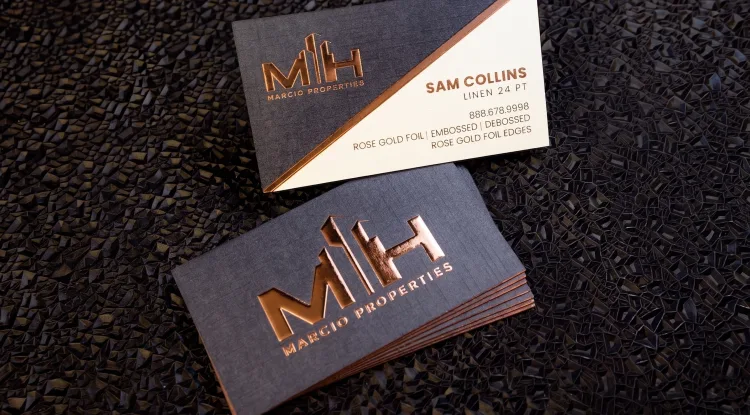
Raised foil is built for professionals whose card needs to signal authority and confidence the instant it changes hands — the thumb finds the logo before the eye finishes reading.
Explore ideas for realtors →Flat foil gets noticed by the eye. Raised foil gets noticed by the hand — the moment someone runs a thumb across your mark and pauses. That pause is what people remember.
The thumb finds the logo before the eye finishes reading. A raised mark invites touch, and touch is what makes a card memorable long after the conversation ends.
A logo, monogram, name, border, or icon — one deliberate brand detail that deserves to be felt.
For professionals whose card needs to signal authority and confidence the instant it changes hands.
Order a free sample kit and feel the raised height, foil color, and stock in your own hands before you order.
A screen can show shine. A sample kit shows height, weight, stock, foil color, and how the card reacts in real light — which is exactly why raised foil is easier to choose in the hand. And it ships free.
Pair with a SilkCards design consultant and designer — upload your logo and our team can flag what will hold raised height, or help create a card that uses raised foil with purpose, not clutter.
Keep Exploring
Metallic foil pressed level with the surface — smooth to the thumb, metallic to the eye.
Explore FoilClear gloss built above the surface — raised clear varnish, no metallic color.
Explore Raised Spot UVFoil applied with a sculpted impression into the stock — relief created by reshaping the card surface.
Explore Emboss
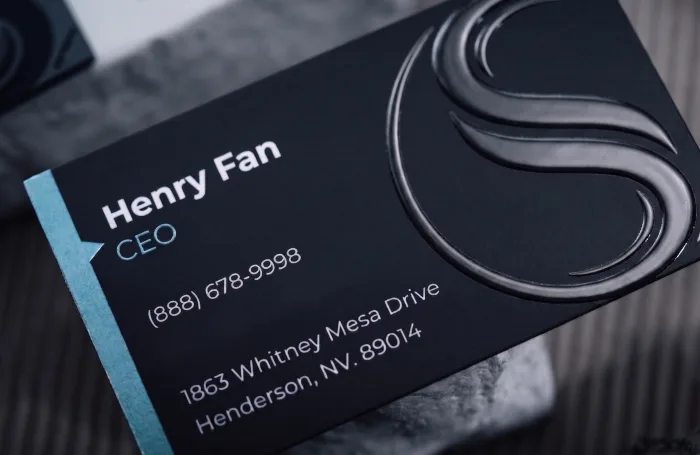
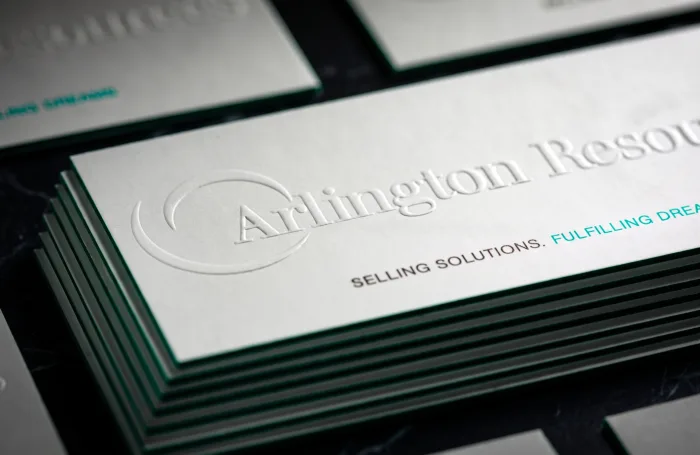
Raised foil is a dimensional choice, not only a color choice — and SilkCards builds it higher than the standard raised foil most printers stop at. The stronger the elevation, the more the foil lifts off the surface.
For refined raised foil that feels premium without overwhelming the design. The thumb finds the logo before the eye finishes reading — that pause is the point.
For logos, symbols, and hero marks that should become the first thing the hand notices. You can dial the height from a refined lift to a bold, maximum-presence raise on a focal mark.

Raised foil works best when it has a clear job. Choose the detail that carries your brand, give it breathing room, then build the stock, foil color, and surrounding finishes around that focal point.
✓ You want your logo, name, or mark to be both seen and felt as the card moves.
✓ You want real height, not a printed metallic look — true raised foil adds real height to your mark.
✓ You want a metallic detail people notice with their eyes and confirm with their hands.
✓ You want variable elevation — from a refined lift to a bold, maximum-presence raise.
✓ You want a premium 32pt+ Silk or Suede foundation that holds the height cleanly.
Logo, name, monogram, icon, signature line, or border — the one detail that carries your brand.
Solid for classic authority, Pearl for softness, Facet, Orbit, and Aurora for movement.
Silk or Suede at 32pt+ gives the raised foil a premium foundation.
Spot UV, emboss, die-cut, color edge, or foil edge can add depth without crowding the design.
3× for refined raised foil that feels premium; 5× for hero marks that should become the first thing the hand notices.
Clean logos, bold marks, monograms, icons, and borders with breathing room hold raised foil best. Very fine hairlines can flatten.
If you’re unsure whether your artwork will hold, our Design Help team can review the file and flag what to adjust before production.
Four finishes get confused constantly. Here’s what each one is, and what your fingertip actually feels.
| Finish | What it is | What the hand feels | Best use |
|---|---|---|---|
| Raised Foil · This page | Metallic foil built up above the card surface. | Raised metal; visible and tactile. | Logo, name, monogram, hero detail. |
| Flat Foil | Metallic foil pressed level with the surface. | Smooth to the thumb; metallic to the eye. | Fine typography, elegant borders, broad foil detail. |
| Raised Spot UV | Clear gloss built above the surface. | Raised clear varnish, no metallic color. | Tone-on-tone pattern, gloss contrast, hidden detail. |
| Foil Emboss | Foil applied with a sculpted impression into the stock. | Relief created by reshaping the card surface. | Crests, seals, premium marks, formal identities. |
Raised foil needs a substantial, premium foundation to hold its height. These SilkCards materials make the strongest bases for it — and each one has its own page when you want to go deeper.
Smooth silk-laminated 32pt+ stock — the premium base raised foil sits highest on.
Soft-touch matte surface that makes raised metallic foil pop with contrast.
Woven texture beneath a smooth raised-foil mark — tactile against tactile.
A metallic cold-foil surface, with raised foil layered on top for added depth.
Deep black stock that throws gold and silver raised foil into sharp relief.
Heavier stock gives the raised foil a firm base, holds the height cleanly, and makes the card feel more premium in the hand.
The strongest raised foil cards do not raise everything. They raise the detail that matters most.
Raised foil needs enough surface area to build clean height. Details that are too fine can flatten or blur.
Logos, icons, initials, and bold lines hold elevation beautifully and feel intentional.
When everything is raised, nothing feels special. The height loses hierarchy.
Use raised foil where the brand lives. Let the surrounding space make it feel more valuable.
The essentials most buyers ask before choosing raised foil — short and to the point.
Cards that carry metallic foil built up above the card surface, so the detail catches light and can be felt by touch. Unlike a printed metallic look, true raised foil adds real height to your logo, name, or mark.
Flat foil is pressed level with the surface — smooth to the thumb, metallic to the eye. Raised foil is built up above the surface, so it’s both seen and felt as the card moves.
Both add height you can feel, but raised foil is metallic and raised Spot UV is clear. Many cards use both — metallic foil for the logo, raised Spot UV for a background pattern.
38 colors across five families: Solid (gold, silver, copper, rose gold, black, white), Pearl, Facet, Orbit, and Aurora — so the finish can match your brand instead of defaulting to metallic.
Raised foil applies metallic foil over a built-up base so the foil rises off the card surface — metal you can feel with a thumb, not flat foil pressed level with the page. SilkCards runs it in 38 foil colors across 5 families on 32pt+ Silk Standard stock.
Both use the same metallic foil; the difference is height. Flat foil (a different process) sits level with the page — metallic to the eye, smooth to the thumb. Raised foil is built up off the surface so it is felt as well as seen, up to 3× or 5× the standard single ~50-micron pass. See our flat foil business cards for the level-with-page version.
Most printers run one ~50-micron pass and state that single fixed number. SilkCards builds raised foil past that single pass with variable elevation — up to 3× or 5× that height — so you control how far the metal stands up off the card. We don't cap height at one number; we build to the effect the artwork needs.
Raised foil is raised metal — opaque metallic color you can feel. Raised Spot UV is raised clear gloss — a high-build varnish with no metal, reading tone-on-tone against the base. Both are built up off the card using the same variable-elevation craft; one carries metallic color, the other carries clear shine. See our raised Spot UV business cards for the clear-gloss version.
All 38 SilkCards foil colors across 5 named families can be run as raised foil: Solid (gold, silver, copper, rose gold, black, white), Pearl (soft pearlescent shimmer), Facet (gem-like multi-tone), Orbit (deep iridescent shift), and Aurora (holographic rainbow). Most printers offer gold, silver, and holographic only.
SilkCards builds raised foil on the Silk Standard — 32 point or thicker with Silk or Suede laminate — with 48pt and 64pt multi-board constructions also available. Most competitors cap raised foil at 16pt (finishing around 19pt). The heavier base gives the raised height something substantial to rise from.
Raised foil business cards apply metallic foil over a built-up base so the foil stands up off the card — most often on the logo, name, or brand mark. The recipient feels the detail before they read it. SilkCards runs raised foil in 38 colors across 5 families on 32pt+ stock; most printers offer 3.
A raised base is built up where the metallic detail belongs, then foil is applied over it under heat and pressure so the metal rises off the surface. The height of that base is what sets raised foil apart from flat foil — and SilkCards controls it with variable, multi-pass elevation rather than a single fixed pass.
No — they are different processes buyers often confuse. Raised foil is foil applied over a built-up base on the card surface. Foil emboss presses foil into a sculpted die so the stock itself is reshaped under the foil. Raised foil rises above a flat card; foil emboss reshapes the card into relief. SilkCards offers both and can combine them on one face.
Raised foil earns its place when the handover matters — when the card has to be felt, turned in the light, and kept. Customers consistently report the same thing after a first raised foil order: people run a thumb across the logo before they read a word. Worth is measured against what a flat, forgettable card costs you at that moment.
Yes. Flat foil is metallic to the eye but smooth to the thumb — it sits level with the page. Raised foil is built up off the surface, so the thumb finds it. That tactile difference, up to 3×–5× the standard single pass, is the whole point of choosing raised over flat.
Neither is better — they do different jobs. Choose raised foil when you want metallic color that stands up. Choose raised Spot UV when you want clear, tone-on-tone gloss height with no metal. Many cards use both: raised metal on the logo, clear raised gloss elsewhere, registered cleanly on the same face.
Three: flat foil (flat metal), raised Spot UV (raised clear gloss, no metal), and foil emboss (foil pressed into a sculpted die). Raised foil is the only one of the four that is both metallic and built up off a flat card surface. Our comparison table lays all four out side by side.
Solid gold and silver remain the most-ordered — gold reads warm and traditional, silver reads modern and precise. Pearl suits soft, refined brands; Facet, Orbit, and Aurora add multi-tone and holographic shift. Order a sample kit and hold the 38 colors against your brand in real light — most buyers pick a foil they hadn't considered.
The 38-color palette across 5 families covers most brand needs directly. For an exact Pantone match outside the standard palette, custom foil is reviewed case by case on quantity and lead time. The sample kit is the strongest starting point — most brands find a closer match than expected before considering custom foil.
Yes. Holographic lives in the Aurora family and shifts through a rainbow as the card moves; Pearl carries a soft iridescent sheen; Facet and Orbit are multi-tone. All can be run as raised foil on the same 32pt+ laminated stock as the Solid family.
Because raised foil is built up, give it a little more room than flat foil: 10 to 12 point text and strokes of 1 point or thicker hold the height cleanly. Below that, the raised foil can flatten or smudge as it builds. When in doubt, request a proof before the full run.
Provide vector artwork (PDF or AI) plus a black-and-white mask showing exactly where the raised foil applies — the mask defines the built-up area. Keep solid color behind the mask so nothing shows through. SilkCards' design team can prep files from any starting point and will flag anything that won't translate before production.
Raised foil performs best as a focal point rather than full coverage — the contrast against the flat base is what makes the height read. SilkCards' multi-pass technique handles broader coverage more reliably than a single pass, but the strongest cards still raise one deliberate detail. Coverage is confirmed at artwork review.
Yes. SilkCards runs raised foil on the front, the back, or both — including different foil colors on each side. Raised foil can also pair with a foil-pressed edge for a card that reads built from every angle. Most printers restrict foil to one side or one color per job.
Raised foil needs a substantial base to rise from. The Silk Standard — 32 point or thicker with Silk or Suede laminate — is the signature foundation, with 48pt and 64pt also available. Cotton suits boutique brands. Heavier laminated stock gives the raised height the cleanest, most durable result.
Yes — and raised metal on soft-touch suede is one of the most-requested combinations: velvet to the thumb, raised metal where the brand lives. SilkCards' suede is a laminated finish, not a coating, so the texture survives pockets and wallets while the raised foil holds its height.
Yes. SilkCards builds raised foil on cotton, linen, and other natural-fiber substrates. Most printers say textured uncoated stocks are not recommended for foil because adhesion can't be guaranteed; SilkCards has built the technique to hold raised foil while preserving the texture buyers chose.
Yes — and it is one of SilkCards' signature moves. Raised metallic foil where the brand lives, clear gloss varnish elsewhere, both registered on the same face. The card works two distinct light registers — metal and gloss — that most printers cannot deliver on one side.
Yes. Embossing raises a mark into the stock itself; raised foil adds built-up metallic color on top. The result catches light and confirms itself under the thumb from two directions at once. Tight registration between the foil and the emboss is critical — SilkCards holds the tolerance most printers let drift.
Yes. SilkCards offers 36 foil-pressed Edge Finishes that pair with any of the 38 face foils — raised metal on the logo, matching or contrasting foil wrapped around the side profile. See our Edge Finishes for the full edge palette. Most printers don't offer foil edges at all.
Yes — multi-finish on one face is a defining SilkCards capability. Raised foil on the front, emboss on the back, clear spot UV detail, and a foil-pressed edge can all live on the same card with tight registration. Most printers limit you to one or two finishes per job.
Properly built and heat-pressed raised foil on laminated stock holds up to normal pocket, wallet, and cardholder use. SilkCards' standard — raised foil on 32pt+ stock with Silk or Suede laminate — protects the metallic surface, and cards ship in protective packaging. If a card arrives with a visible defect, SilkCards reprints.
Not when the base is built and the foil is laid correctly, which is why height control matters. A single thin pass over fine detail is where lesser raised foil fails; SilkCards' multi-pass, variable-elevation build keeps the metal anchored to its base even on taller raised areas.
Most logos with confident shapes and breathing room translate cleanly and hold their height well. Very fine lines, micro-text, or tight gradients can flatten as the foil builds up. SilkCards' design team reviews every file and flags any element that won't hold raised height before production begins.
Yes — SilkCards' variable elevation supports distinct height tiers in one design. The logo can rise toward 5× the standard pass while a surrounding pattern rises 1× or 2×. Most printers offer one raised height per job at roughly 50 microns. Variable elevation gives the card built-in hierarchy you can feel.
Yes — SilkCards runs multiple raised foil colors on the same face: two colors on one card, or a face color plus a different edge foil, all registered cleanly. Most printers restrict you to one foil color per job. Cross-family combinations (Solid + Aurora, Pearl + Facet) are part of the core capability.
Yes — the Silk Standard begins at 32 point with Silk or Suede laminate, with 48pt and 64pt multi-board builds available. Most competitors cap foil at 16pt (finishing around 19pt). SilkCards' baseline is roughly twice that, and the raised foil holds its height across every weight.
Yes — tight registration is what makes raised foil on an emboss land. SilkCards holds production tolerances tight enough that the raised metal sits cleanly on the raised form. Most printers offer both finishes but let registration drift; the alignment is where the craft shows.
Yes — full die-cut customization with the raised foil intact: rounded corners, custom silhouettes, scalloped edges, or face cuts. The foil registers cleanly with any cut shape. Many printers restrict foil to standard rectangular cards; SilkCards treats raised foil plus die-cut as a core combination.
Yes — the substrate library is a defining SilkCards capability. Raised foil runs on cotton, linen, suede and silk laminate, plus select wood, metal, and plastic substrates. Most printers restrict foil to standard 14–16pt paper. SilkCards treats material variety as part of the core raised foil offer.