Raised Spot UV + Suede
Learn about Suede →Velvety soft-touch suede beside clear raised gloss is the strongest tactile contrast on the menu — the thumb feels both at once.
Starting at $99 · 250 cards
Shop this Combination →

Raised Spot UV adds clear, dimensional gloss to the parts of your design that deserve attention — a logo, name, mark, icon, or pattern. SilkCards defaults to a higher 3x raised UV pass for stronger depth and feel, with up to 6x pass height available on qualified designs.
From $70 · 250 cards
Velvety soft-touch suede beside clear raised gloss is the strongest tactile contrast on the menu — the thumb feels both at once.
A smooth silk-laminate surface gives raised gloss a clean, soft base — the matte-to-gloss contrast makes the height read at a glance.
Layer metallic cold foil with raised Spot UV for shine and dimension together on a single card.
Raised gloss on the face, color or foil on the side — use the edge as another brand surface.
Deep onyx black with raised clear gloss — tone-on-tone gloss that appears only when the light moves across it.
Thicker stocks give the raised detail a stronger foundation, so the card feels intentional before the gloss is even noticed.
Real feedback from trusted professionals who expect more than ordinary business cards.
We've helped brands turn paper, height, texture, and finish into confidence that makes stronger first impressions.
Get a sample kit and feel the raised height, texture, and weight for yourself before you build.
Get guidance on the right combination of raised height, stock, texture, and edge detail.
“I cannot thank this company enough! My business cards are absolutely fabulous and I have received so many compliments on them. The pictures will not do them justice. I got the suede finish, 48 pt thick cards with silver foil on one side and the edges. They are so luxurious.”
Raised Spot UV is ideal when your card needs to create curiosity without looking overdecorated.
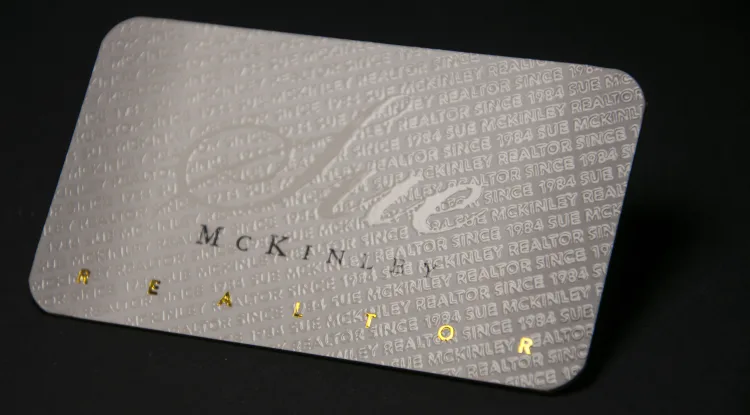
Highlight a logo, brokerage mark, or name so the card feels more polished after a showing or open house.
See realtor ideas →Raised Spot UV doesn’t shout in color. It wins through contrast: matte beside gloss, flat beside raised, stillness beside a flash of reflected light. Built higher by default, the detail registers twice — once to the eye, once to the thumb.
The gloss appears as the card turns, so your logo or mark earns a second look in the hand.
SilkCards lays a 3x raised UV pass for real depth — up to 6x on qualified designs.
Choose the detail that should rise first, then build the stock, foil, and edge around it.
The added height makes logos, marks, names, and patterns more apparent. The card does not just catch light — it gives the hand something to find.
Raised Spot UV is one of those finishes you understand faster in the hand than on a screen. The sample kit lets you compare flat gloss, the SilkCards 3x raised gloss, foil, suede, silk, thickness, and edge finishes before you order — and it ships free.
Pair with a SilkCards design consultant and designer to map the raised Spot UV mask, stock, and finish pairings — so the final card feels intentional.
Keep Exploring
Same clear gloss family, but without raised height — subtle shine against dimensional gloss.
Explore Spot UVRaised, but metallic. Choose raised foil when the detail should look like metal and stand up from the card.
Explore Raised FoilMetallic detail that reads as gold, silver, copper, or color metal — shine without the raised height.
Explore Foil
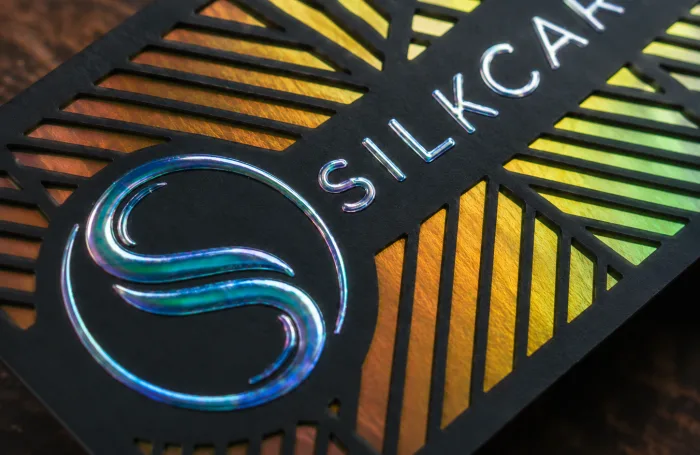
The real moat is height. Many raised UV cards in the market read as a low-relief surface effect. SilkCards defaults to a 3x raised UV pass so the gloss has more apparent depth, more stand-out, and more feel under the thumb.
Our standard build gives the clear gloss stronger height and a more obvious tactile presence — the comparison that matters is how much depth your thumb actually finds.
For qualified designs, we can build raised Spot UV higher for a stronger dimensional gloss effect. The card does not just catch light — it gives the hand something to find.

Raised Spot UV works best on one confident focal point — a logo, monogram, bold type, an icon, a border, or a clean pattern. From there, the stock, foil, and edge get built around the detail that should rise first.
✓ You want clear gloss with visible, touchable height.
✓ You want to highlight logos, names, icons, bold marks, or focal patterns.
✓ You want a stronger pause at the handoff — the thumb finds the raised detail.
✓ You want a finish that pairs with suede, silk, foil, foil edges, color edges, and multi-board stocks.
✓ You want more height than typical raised UV — SilkCards defaults to a 3x pass, up to 6x on qualified designs.
Logos, monograms, bold type, icons, borders, and clean patterns. Less coverage usually creates more impact.
SilkCards defaults to a 3x raised UV pass — up to 6x pass height available on qualified designs.
Works across premium stocks, including suede and silk surfaces and thick multi-board constructions from 16pt up to 32, 48, or 64pt.
A raised Spot UV order needs your printed artwork plus a separate mask file that marks exactly where the clear gloss should sit.
Raised Spot UV pairs with foil, edges, suede, and silk — keep one finish as the hero so the card reads clearly rather than competing for attention.
Raised Spot UV can be applied to the front, the back, or both, each with its own mask — a front hero detail with a quieter raised pattern behind.
Send your logo, existing card, sketch, or rough idea. SilkCards can help recommend the raised Spot UV mask, stock, finish pairings, and artwork adjustments so the final card feels intentional.
Clear gloss, flat gloss, or raised metal — the difference is what happens when the card is in someone’s hand. With SilkCards, the raised gloss is built higher by default.
| Question | Raised Spot UV | Spot UV | Raised Foil |
|---|---|---|---|
| Best feel | Clear gloss with visible, touchable height. | Clear gloss contrast without touchable elevation. | Raised, but metallic — reads as gold, silver, copper, or color metal. |
| Best for | Logos, names, icons, bold marks, and focal patterns. | Tone-on-tone backgrounds, light patterns, and sleek minimal cards. | Details that should look like metal and stand up from the card. |
| Design personality | Creates a stronger pause at the handoff — the thumb finds the raised detail. | More understated — quiet polish for clean, professional cards. | Dimensional metallic presence, seen and felt. |
| Finish pairings | Suede, silk, foil, foil edges, color edges, and multi-board stocks. | Choose it when you want subtle shine without relief. | Choose it when the metallic detail should be seen and felt. |
Raised gloss reads strongest against a surface it can contrast. These SilkCards stocks make the 3x raised detail look and feel intentional — and each one has its own page when you want to go deeper.
A smooth silk-laminate surface gives raised gloss a clean, soft base — the matte-to-gloss contrast makes the height read at a glance.
Velvety soft-touch suede beside clear raised gloss is the strongest tactile contrast on the menu.
Woven linen texture under a precise raised gloss detail — an organic surface meets deliberate shine.
Layer metallic cold foil with raised Spot UV for shine and dimension together on a single card.
Deep onyx black with raised clear gloss — tone-on-tone gloss that appears only when the light moves across it.
Thicker stocks give the raised detail a stronger foundation, so the card feels intentional before the gloss is even noticed.
The strongest cards use raised Spot UV deliberately rather than coating the whole design. These are the choices we steer customers away from — and what to do instead.
When the gloss covers everything, the raised detail has no room to catch light and stand out from the matte around it.
A logo, monogram, bold type, an icon, a border, or a clean pattern. Less coverage usually creates more impact.
Stacking every finish on one card keeps it from reading clearly.
Raised Spot UV pairs with foil, edges, suede, and silk when the artwork is built correctly — let the raised detail lead.
A raised Spot UV order needs your printed artwork plus a separate mask file that marks exactly where the clear gloss should sit.
SilkCards can review your art or build the mask for you through Design Help, so the raised gloss lands precisely on the detail you want to lift.
The essentials most buyers ask before choosing raised Spot UV — short and to the point.
A clear gloss varnish built up on selected artwork so the design has shine and height you can feel. SilkCards defaults to a stronger 3x raised UV build.
Flat Spot UV adds glossy contrast with no real height; raised Spot UV builds the clear gloss higher so the detail is both seen and felt.
Because height matters. Our default 3x raised UV pass creates more depth and stand-out than a light, low-relief gloss effect.
Logos, monograms, bold type, icons, borders, and clean patterns. Less coverage usually creates more impact.
Raised Spot UV is a clear, dimensional gloss varnish built up thick on selected areas of a card — a logo, name, or pattern — so it stands off the surface. You see the shine and feel the height. It is not metallic and not a press into the paper; it is an additive clear coating. SilkCards builds it on 32pt+ Silk Standard stock.
Both are the same clear gloss varnish. Flat Spot UV sits level with the surface — you see the shine but feel no height. Raised Spot UV is built up thick so it stands off the card and the thumb finds it. SilkCards builds the raised version beyond the single ~50-micron pass most printers cap at — up to 3× or 5× that height via multi-pass.
Most printers offer a single fixed pass of about 50 microns. SilkCards builds the clear varnish up beyond that — controllable, variable elevation up to roughly 3× or 5× that height via multi-pass. The gloss can even rise in distinct tiers across the same card, giving the design a hierarchy you can feel under the thumb.
Competitors contradict each other here — quoting anywhere from 30% to 75% coverage. The honest answer is craft, not a percentage: raised gloss reads strongest as a deliberate accent on a logo or key element, where the height carries weight. Full coverage starts to look plasticky. The design team confirms what holds cleanly for your artwork and build height.
SilkCards builds raised Spot UV on the Silk Standard — 32 point or thicker, with 48 point and 64 point multi-board constructions also available. Most competitors apply raised gloss to 16–19pt soft-touch stock. The thicker base gives the raised varnish a substantial card to sit on, so the whole object feels considered, not just the gloss.
No. Unlike emboss — which presses the stock into a raised shape and always shows on the reverse — raised Spot UV is an additive clear coating built on top of the card. The face is raised; the back stays clean. Nothing is pressed through the paper, so there is no reverse impression.
Smooth, glossy, and noticeably raised — the clear varnish stands off the surface, so a thumb tracks the logo before the eye finishes reading it. Customers consistently say the finish makes a recipient slow down and engage from curiosity. The height is built past the single ~50-micron pass most printers stop at, up to 3× or 5× that, on 32pt+ stock.
Yes — these are all names for the same finish: clear gloss varnish built up thick so it has height. "3D spot UV," "textured spot UV," and "high-build UV" all describe raised Spot UV. The thing that varies between printers is how high it's built. SilkCards builds variable elevation up to 3× or 5× the standard single ~50-micron pass.
Both rise off the card and both are felt — the difference is what's raised. Raised Spot UV is clear gloss varnish: no color of its own, it reads against the print beneath it. Raised foil is raised metallic — colored foil with height. Choose raised Spot UV for tone-on-tone shine; choose raised foil when you want metal that stands up. See raised foil →
Flat Spot UV gives clean gloss with no height — ideal for subtle tone-on-tone patterns where you want shine but not relief. Raised Spot UV adds dimension you can feel, built up to 3× or 5× the single pass. If the goal is for the recipient to touch the detail, choose raised. See flat Spot UV →
No. Emboss presses the stock itself into a raised shape, which always leaves a reverse impression on the back. Raised Spot UV builds clear varnish on top of the card — an additive coating. The face is raised, the back stays clean. Same dimensional goal, opposite process: emboss deforms the paper; raised Spot UV adds to it.
Provide two layers: the full CMYK design, plus a separate black-and-white mask showing exactly where the raised gloss applies — solid black where you want varnish, white everywhere else. Vector (PDF or AI) keeps edges crisp. The SilkCards design team can also build the mask from your artwork — Canva, raster, or a sketch. Send what you have; they'll tell you what's missing.
The taller the build, the larger the detail needs to be. As a guide, keep text at 8–10pt or above and strokes at roughly 1pt or thicker; for the highest builds, give detail more room. Below those thresholds, fine lines can fill in as the varnish stacks. The design team reviews every file and flags anything too fine for the height you want.
Confident shapes — logos, monograms, icons, bold type — hold raised gloss cleanly. Because the varnish is clear, it reads against the color beneath it, so a solid, contrasting base makes the gloss pop and the height register. Busy or low-contrast art under the mask dilutes the effect. Keep the raised area deliberate, not decorative.
Yes. SilkCards can apply raised gloss to the front, the back, or both — and at different build heights on each side if the design calls for it. Because it's an additive coating with a clean back, front-and-back raised gloss doesn't fight itself the way two-sided emboss can. The design team confirms registration for double-sided builds.
Yes — this is one of SilkCards' clearest advantages. The logo can rise at 5× the standard height while a surrounding pattern rises 1× or 2×, all on the same card. Most printers offer one fixed raised height per job at roughly 50 microns. Variable elevation gives the design built-in hierarchy you can feel.
Yes — that's the SilkCards baseline. Raised Spot UV builds on the Silk Standard at 32 point, with 48 point and 64 point multi-board constructions also available. Most competitors apply raised gloss only to 16–19pt soft-touch stock. The heavier base gives the raised varnish a substantial card to live on.
Yes — and the contrast is the point. A suede or soft-touch surface reads matte and velvety to the hand; the raised clear gloss sits on top as a smooth, dimensional accent. Matte against raised gloss is one of the most-requested raised Spot UV combinations because both registers are felt at once.
A smooth, laminated 32pt+ base carries raised gloss best — the Silk Standard with silk or suede laminate is the signature foundation. Cotton suits boutique brands wanting natural fiber with one clear gloss accent. Heavily textured uncoated stocks are workable but the design team will advise where the build height and texture may compete.
Yes — and on the same face, registered tight. Foil gives metallic shine on one element; raised clear gloss gives dimensional shine on another. The card then works in two registers — metal and clear height — which most printers cannot deliver on a single side. It's one of SilkCards' signature multi-finish moves.
Yes. SilkCards combines raised gloss on the face with a band of edge color around the card's side profile, registered tight. The card reads finished from every angle — raised where the brand sits, colored where the eye meets the edge. Most printers treat these as separate jobs; SilkCards builds them on one card.
Yes — using both registers of the same varnish on one card. Flat gloss for a subtle tone-on-tone pattern, raised gloss for the logo that should stand up and be touched. The two heights of the same clear coating give a quiet, sophisticated layering that reveals itself only as the card turns.
Raised gloss on a soft-touch or suede base is the most-requested — matte velvet across the surface, clear raised gloss on the logo. Close behind: raised Spot UV plus a band of edge color, and raised gloss plus foil on one face. SilkCards can register all three together on a single 32pt+ card.
Properly cured high-build varnish on laminated 32pt+ stock is durable for normal pocket, wallet, and card-holder use. The clear coating is bonded to the card, not a sticker on top. Cards arrive in protective packaging. If a card arrives with a visible defect, SilkCards reprints — the standard is a finish that holds, not one that flakes.
Not when it's used as an accent. Full-coverage gloss is what reads plasticky; a deliberate raised detail on a 32pt+ Silk Standard card reads crafted. The thick, smooth varnish has the depth of glass, not the flat sheen of laminate film. The honest guidance from the design team: reserve the height for the detail that matters.
Multi-pass build height adds a curing stage, so raised Spot UV orders take a little longer than flat-printed cards — the design team commits to a realistic timeline during proofing, plus shipping. Highly custom builds — variable elevation, multi-finish, edge color — can take longer. Honest dates beat optimistic ones.
Most logos translate cleanly. Bold marks, confident strokes, and breathing room around the detail hold raised gloss best. Very fine lines, micro-text, or tight gradients can fill in as the build height increases. SilkCards' design team reviews every file and flags any element that may not hold at the height you want before production begins.
It earns its place when the card needs to do work in the handover — when you want it touched, not filed. Customers consistently describe the same outcome: the recipient slows down, runs a thumb across the detail, and engages from curiosity. Worth is measured by what the card replaces. A missed first impression costs more than a dimensional finish.
Professionals whose handover carries weight — designers proving taste, founders and personal brands, realtors, attorneys, medspas, luxury and hospitality brands. The pattern across SilkCards' customers: raised gloss works hardest where the card has to walk into the room before you do, on 32pt+ stock that feels as considered as the finish.
Three honest cases. One: when it would patch a design that isn't working — gloss amplifies good design, it doesn't rescue weak design. Two: when the artwork is all fine detail that won't hold at build height. Three: when you want metallic color, in which case raised foil is the better finish. The design team will say so plainly.
Yes — this is SilkCards' primary raised Spot UV advantage. Most printers offer one fixed pass of about 50 microns. SilkCards builds the clear varnish up beyond that with controllable, variable elevation up to roughly 3× or 5× that height via multi-pass. The gloss genuinely stands off the card rather than just catching light.
Yes — the Silk Standard begins at 32 point with silk or suede laminate, and 48pt and 64pt multi-board constructions carry raised gloss equally well. Most competitors cap raised Spot UV at 16–19pt soft-touch stock. SilkCards' baseline is roughly twice that thickness, so the card feels as substantial as the finish.
Yes — on a single face, registered tight. Raised clear gloss on the logo, metallic foil on another element, a band of edge color around the profile. Most printers limit a job to one or two finishes, rarely on the same side. SilkCards treats this combinatorial finish architecture as part of the core raised Spot UV offer.
Yes — variable elevation across one card. The logo can rise at 5× the standard height while a surrounding pattern rises 1× or 2×, distinct tiers in the same artwork. Most printers offer one raised height per job at roughly 50 microns. The technique builds visual hierarchy into the card that you can feel as well as see.
Yes — raised face, clean back. Because raised Spot UV is an additive clear coating rather than a press into the paper, there is no reverse impression like emboss leaves. The detail stands up on the front while the back of the card stays flat and clean — useful when the reverse carries its own design.
Yes — SilkCards registers raised gloss cleanly with custom die-cut silhouettes, rounded corners, and face cuts. The varnish holds its height around the cut shape. Most printers restrict specialty finishes to standard rectangular cards. SilkCards considers die-cut plus raised gloss a core combination, not an exception.
Yes — beyond standard paper, SilkCards builds raised gloss on cotton (boutique register), suede and silk laminate, and select premium substrates. Most printers default raised gloss to one thin soft-touch stock. SilkCards treats material variety as part of the core raised Spot UV capability, so the base can match the brand.
Yes — and tight registration is what makes tone-on-tone raised gloss work. SilkCards holds tolerances tight enough that the clear varnish sits precisely over its printed element, so the gloss appears to grow out of the color rather than float beside it. Loose registration is what makes lesser raised gloss look like an afterthought.